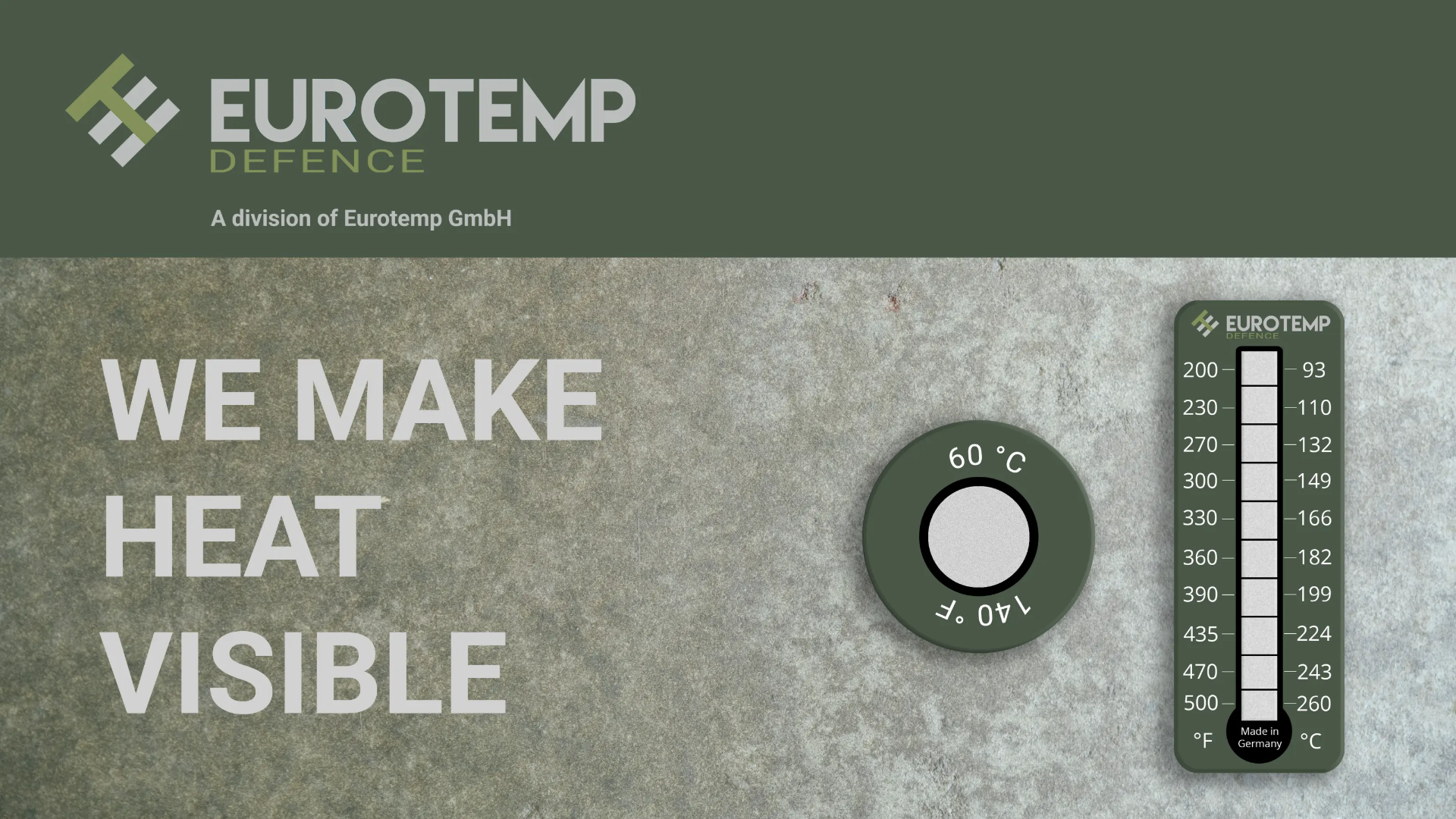
Make invisible heat visible.
Self-adhesive temperature indicators that turn from white to black at a defined threshold. They show, before anyone touches it, whether sensitive material got too hot – prioritizing the protection of the person using it. No power, no electronics, no software.
MSPO 2026
8. - 11. September Hall 3
THE LÄND - German Pavilion
Freely selectable thresholds
37,8 - 264 °C
No power, no battery
0 W
Readings remain permanently visible
Irreversible
To a tamper-evident decision
<3 seconds
Know the heat. Control the risk. Protect the mission.
Evidence, warranty and documentation matter. The person who opens the crate, fits the battery or holds the weapon matters more. Overheated material looks unchanged – until it fails. The indicator makes the danger visible before anyone touches it.
Whatever the use case, the same rule applies: white – continue checks. Black – isolate, document, inspect. Protecting the user comes first; the evidence for warranty, maintenance and investigation follows from it.
Cook-off in ammunition
Ammunition that has passed its thermal limit can self-ignite – in the barrel, in the crate, in transit. The indicator marks the affected unit before anyone handles or loads it.
Battery thermal runaway
An overheated LiPo looks like every other – until it burns in a hand, a vehicle or an aircraft. Three seconds of looking before fitting it turns a risk into a decision.
Thermally overloaded components
Receivers, suppressors, barrels and power units that have passed their limit can fail on the next use – in the user's hands. The indicator records the exceedance, so the part is inspected instead of being used on blindly.
Silently weakend protective gear
Ballistic plates and composite parts lose strength after heat exposure – with no visible damage. The indicator reveals the pre-damage before the equipment is worn.
Heat leaves no trace
The crate that stood three days in the sun looks like every other. So does the battery that got too hot – until it burns. The thermal history is there. It is simply not visible. The outside may look intact. But if there is no record of heat exposure, there is no evidence. And assumption quickly becomes cost.
Apply straight onto the object
Attaches to steel, aluminium, plastic and cardboard. Per crate, per battery, per housing, per packaging unit. Format and layout to your spec.
Trigger at your threshold
When the defined temperature is exceeded, the field flips: white to black. Purely physical, no moving parts.
Read the results
White – continue checks. Black – isolate, document, inspect. One photo is the record for the file.
Reliable readings - permanently
The colour change is final. That is exactly what makes it dependable: it answers, months later, whether a part was ever above its limit – regardless of whether anyone was there to see it. The change cannot be erased or reset. What has triggered stays triggered – in an investigation report as in a dispute.The question is not "how warm is it now" but "was the limit exceeded – at some point, somewhere". That is precisely the question that decides use or quarantine in the field. After triggering, the part is inspected and a new indicator applied. The triggered one stays with the records as evidence – photographed or in original form.
Temperature range
From +37.8 °C to +264 °C.
Any threshold in between is possible – as a single field or as a multi-step ladder that maps the whole temperature progression.
Ammunition depots and containers in the sun, LiPo packs, field cold chain, medical goods, electronics in transit
Hydraulics, gearboxes, vehicle electronics, fire-control computers, composites
Engine and drivetrain, bearings, brakes, weapon receivers under sustained fire, suppressors
Turbine and exhaust vicinity, workshop inspection after overload, lock-out criterion at thermal softening
From small arms to 155 mm systems
Whatever your use case may be - we have the right indicator for it.
Ammunition & Explosives
49 - 70 °C
Heat history per crate. Triage after a fire or heat event, prioritising hot-stored lots, cook-off indication.
Drones & UAV Batteries
45 - 60 °C
One indicator per pack. Three seconds of visual check before every launch – thermal runaway risk becomes visible before it announces itself.
Vehicles & Drivetrain
90 - 130 °C
Engine, hydraulics, gearbox. Damage appears weeks after the overheating – the indicator is the proof of it, and the maintenance trigger before it.
Field Logistics & Containers
40 - 80 °C
Inside a closed container in the sun, 80+ °C can be reached. Whoever accepts the delivery is liable – and gets the basis for that decision here.
Electronics & Optics
70 - 105 °C
Radar, avionics, radios, thermal and night vision. Separates a manufacturing defect from heat exposure after delivery – and with it, who pays.
Small Arms & Receivers
130 - 264 °C
Multi-step ladders show how hot a weapon got under sustained fire – warning band, pre-cook-off, lock-out criterion.
Why this works in the field
Sensors, data loggers and cold-chain monitoring solve the same problem – expensively, dependent on power, and readable only on a screen. The indicator is the affordable alternative: it costs a fraction, needs no power source, and is understood by any soldier, storeman or inspector without a single minute of training. And it warns where the danger arises – on the object, before anyone touches it.
User protection first
The warning sits on the object, not in a system. Whoever reaches for it sees it – cook-off, thermal runaway and hot components become recognisable before they hurt anyone.
Readable by anyone
White or black. No manual, no training, no language barrier – including in coalition operations.
Evidence on the individual object
Not per depot, not per pallet. Per crate, per battery, per housing – down to the smallest packaging unit.
No attack surface
No firmware, no radio link, no data. Nothing to hack, nothing to jam, nothing that reveals a position.
Retrofittable immediately
No interference with existing systems, no IT integration, no change to equipment approval. Just apply it.
No power, no battery
Nothing to run flat, fail or recharge. Works in the fourth month of deployment as on day one.
The affordable alternative
A fraction of the cost of a data logger – affordable for every single unit for the first time, instead of just the pallet.
Tamper-evident and defensible
The irreversible change cannot be reset. What has triggered stays triggered .
A decision in three seconds
No read-out, no device, no software. Look, decide, document with a photo.
Where temperature evidence is required or recognized.
These standards describe the context in which our indicators are used; they are not a declaration of conformity. Which requirement applies to your procurement is something we clarify from your specification.
STANAG 4440 / AASTP-1
STANAG 4382
STANAG 4240
STANAG 4657 / AASTP-5
STANAG 4703
MIL-STD-810H
MIL-STD-129R
MIL-STD-648D
MIL-STD-2073-1E
AQAP 2110
DEF STAN 00-35
NATO AAP-48
UN 38.3
IEC/EN 62619
IATG 06.50